We took a detector that had learned ships in daylight, and taught it Sentinel-1 radar.
Twelve epochs of RTMDet-S on the VH chips of OSSDD reached 88.54% AP50 on the held-out test. It found 95.5% of the ships, in 45 minutes.
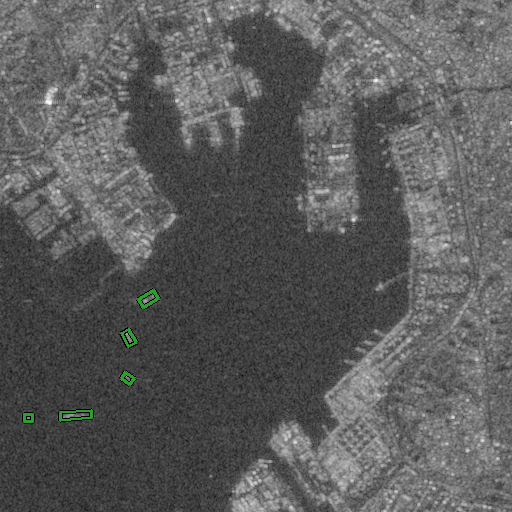
The same recipe with the other two heads is below. Every row is the held-out test: 3,036 chips, empty chips kept, 14,145 rotated ships.
| Model | AP50 | Precision | Recall | Wall |
|---|---|---|---|---|
| RTMDet-S 1× | 88.54% | 88.0% (13,508 / 15,345) | 95.5% (13,508 / 14,145) | 45 min |
| Rotated Faster R-CNN 1× | 70.53% | 91.2% (11,004 / 12,072) | 77.8% (11,004 / 14,145) | 2 h 55 min |
| Rotated FCOS 1× | 52.70% | 93.0% (7,965 / 8,560) | 56.3% (7,965 / 14,145) | 1 h 29 min |
Rotated boxes, exact polygon IoU. 11-point AP at IoU 0.5. Boxes below score 0.3 are left out of the integral. Precision and recall use that same IoU and score.
Hammer et al. Table 6 uses a second score. Precision and recall are at IoU 0.2 and confidence 0.3. mAP is the mean of the area under the precision-recall curve from IoU 0.10 to 0.95. The first column of mAP keeps boxes down to score 0.05. The second drops boxes below 0.3.
| Model | Precision (IoU 0.2) | Recall (IoU 0.2) | mAP 0.10–0.95, score ≥ 0.05 | mAP 0.10–0.95, score ≥ 0.3 |
|---|---|---|---|---|
| RTMDet-S | 90.1% (13,831 / 15,345) | 97.8% (13,831 / 14,145) | 69.09% | 68.08% |
| Rotated Faster R-CNN | 93.8% (11,320 / 12,072) | 80.0% (11,320 / 14,145) | 60.10% | 54.60% |
| Rotated FCOS | 94.3% (8,070 / 8,560) | 57.1% (8,070 / 14,145) | 62.65% | 39.24% |
| Hammer Faster R-CNN | 74.42% | 89.42% | 70.18% | |
| Hammer FCOS | 84.24% | 80.91% | 69.61% | |
| Hammer DETR | 74.44% | 88.91% | 59.99% |
Rotated boxes, exact polygon IoU, for our three rows. The paper rows are axis-aligned ResNet-50 models trained from scratch. The AP50 table is one IoU. This table is the paper’s average over eighteen IoUs.
This sits next to the earlier SAR notes, and it is a different set. SSDD is 1,160 mixed-sensor chips and a native loader. HRSID is 5,604 higher-resolution chips. OSSDD is Sentinel-1 only, float amplitude, and an official val that is not the test.
The dataset Link to heading
Hammer et al. cut 15,197 patches per polarization from 41 Sentinel-1 GRD scenes. Splits are scene-disjoint. Land and water are balanced across splits. Table 3 of the paper, rotated boxes:
| Split | Chip | Patches | Rotated ships | In training? |
|---|---|---|---|---|
| train | 700×700 | 10,666 | 37,236 | Yes |
| val | 512×512 center crop | 1,495 | 2,040 | No — checkpoint pick |
| test | 512×512 center crop | 3,036 | 14,145 | No |
Rotated boxes that crossed the val or test crop were dropped, so the rotated count is lower than the axis-aligned count (test AABB is 15,573 ships). We train and score the rotated boxes.
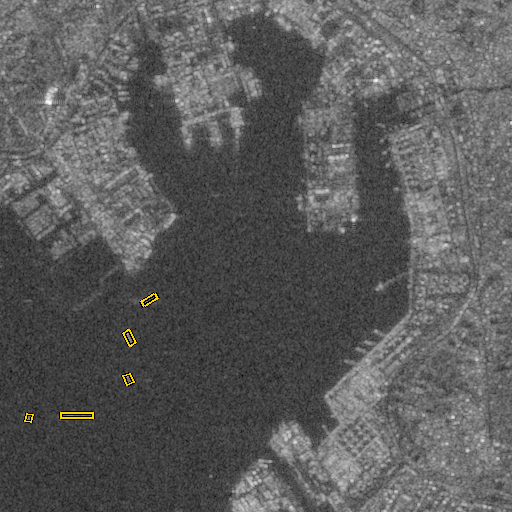
filter_empty_gt drops empty chips from train and from the in-train val. That val is 923 non-empty chips and all 2,040 rotated ships. Test scoring keeps the empty chips: all 3,036.
The network sees 512×512. Train chips are random-cropped from 700. Val is already a center crop. ossdd_to_dota.py clips non-positive amplitudes and values above 20000, applies log10, then per-chip min-max, and repeats the gray chip to RGB. The recipe then uses the DOTA checkpoint mean and standard deviation, so the finetune sees the same input scale as the Hub weight. The paper’s own runs convert to decibels and then min-max; after a per-chip min-max those two scales match.
Download ossdd.zip only (14.4 GB). Extracted chips are about 58 GB. The Hub total is larger because the WebDataset shards are a second copy.
hf download sylviaHoch/OpenSARShip-Ship-Detection-Dataset \
  ossdd.zip --repo-type dataset --local-dir /path/to/data/OSSDD
unzip /path/to/data/OSSDD/ossdd.zip -d /path/to/data/OSSDD
python tools/ossdd_fix_tiff.py --data-root /path/to/data/OSSDD
python tools/ossdd_to_dota.py \
  --data-root /path/to/data/OSSDD \
  --output-dir /path/to/data/OSSDD-dota \
  --polarization VH
The 700×700 train TIFFs are tagged photometric 34892. Pillow will not open them until ossdd_fix_tiff.py rewrites that tag to MinIsBlack. Pixel bytes stay put. Val and test chips are already fine.
odet train --config configs/rotated_rtmdet/ossdd_le90_vh_1x_s.json
odet train --config configs/rotated_faster_rcnn/ossdd_le90_vh_1x.json
odet train --config configs/rotated_fcos/ossdd_le90_vh_1x.json
VV is the same export with --polarization VV and the paths pointed at that folder. We did not log a VV comparison. In the paper, VV is the weaker band (their Faster R-CNN mAP 62.28% versus 70.18% on VH).
What the three trains actually were Link to heading
Each run starts from a DOTA Hub checkpoint. The 15-way classification layer is skipped and re-initialized for ship.
| Init | Schedule | Batch | Checkpoint | |
|---|---|---|---|---|
| RTMDet-S | hf://rotated_rtmdet_dota_le90_3x | 12 ep, AdamW 2.5e-4, cosine from epoch 6 | 8 | runs/rotated_rtmdet/20261005-143859/checkpoints/best_mAP_0.78.pth |
| Rotated Faster R-CNN | hf://rotated_faster_rcnn_dota_le90_1x | 12 ep, the 1× schedule | 2 | runs/rotated_faster_rcnn/20261006-025419/checkpoints/best_mAP_0.40.pth |
| Rotated FCOS | hf://rotated_fcos_dota_le90_1x | 12 ep, the 1× schedule | 2 | runs/rotated_fcos/20261006-012500/checkpoints/best_mAP_0.28.pth |
RTMDet’s only DOTA Hub weight is the 3×. The ResNet families still follow the 1× finetune rule. production.score_threshold 0.3 on these recipes is untuned. The tables use these best checkpoints. Faster R-CNN and FCOS 3× configs are in the tree (36 epochs, milestones 24 and 33, batch 4). Those runs are not the tables.
Links Link to heading
- OSSDD paper · Hugging Face · RTMDet recipe
- SSDD · HRSID · v0.4.0
- Previous: Oriented-Det v0.4.0
- Next: le90 (19 Oct)