HRSC2016 is a small ship set whose test images stay out of training. The score below is on that holdout.
Three Hub weights, all 3×: Oriented R-CNN 90.41%, Faster R-CNN 88.77%, FCOS 88.34%. The curves, and how to download them, follow.
odet pretrained download oriented_rcnn_hrsc2016_le90_3x
odet pretrained download rotated_faster_rcnn_hrsc2016_le90_3x
odet pretrained download rotated_fcos_hrsc2016_le90_3x

odet image-demo path/to/test.bmp hf://oriented_rcnn_hrsc2016_le90_3x \
  --score-thr 0.85 --nms-thr 0.1 --out-file out_orcnn.png
Faster R-CNN uses the same 0.85. FCOS likes 0.20, because its scores sit lower. Keep --nms-thr 0.1. The published mAP above is score ≥ 0.05. Inference is one whole-image forward.
The dataset Link to heading
Liu, Yuan, Weng, Yang, ICPRAM 2017. High-resolution optical ships from Google Earth, oriented boxes, one class we actually train: ship. Fine-grained Class_ID values in the XML are ignored.
The original escience.cn page is often offline. Use a copy of the official 2016 release, not HRSC2016-MS:
| Source | Notes |
|---|---|
| IEEE DataPort | ~3.5 GB HRSC2016_dataset.zip; free IEEE account |
| Baidu AI Studio | Same layout MMRotate points at |
Kaggle guofeng/hrsc2016 | kaggle datasets download -d guofeng/hrsc2016 |
Point dataset.data_root at the folder that contains FullDataSet/ and ImageSets/ (a wrapping HRSC2016/ directory is accepted):
HRSC2016/
  FullDataSet/AllImages/*.bmp
  FullDataSet/Annotations/*.xml
  ImageSets/{train,val,test,trainval}.txt
The paper quotes 1,061 images as 436 train / 181 val / 444 test. The ImageSets we actually train against are trainval 617 (436 + 181) and test 453 (15 of those empty). filter_empty_gt drops the empties from the training-loop val loader (438 kept); make eval-val scores all 453.
| Split | Images | Ships | In training? |
|---|---|---|---|
| ImageSets trainval | 617 | 1,748 | Yes |
| ImageSets test | 453 (15 empty) | 1,228 (1,188 in VOC AP) | No |
XML mbox_cx/cy/w/h/ang is a rotated box with angle in radians. The loader (dataset.format: hrsc2016) converts through the same polygon → RBox path as DOTA, so training is le90.
Unlike DOTA, these images fit a whole-image canvas. No odet tile-dota for the Hub recipes. Optional export exists (odet hrsc-to-dota) if you want DOTA folders anyway.
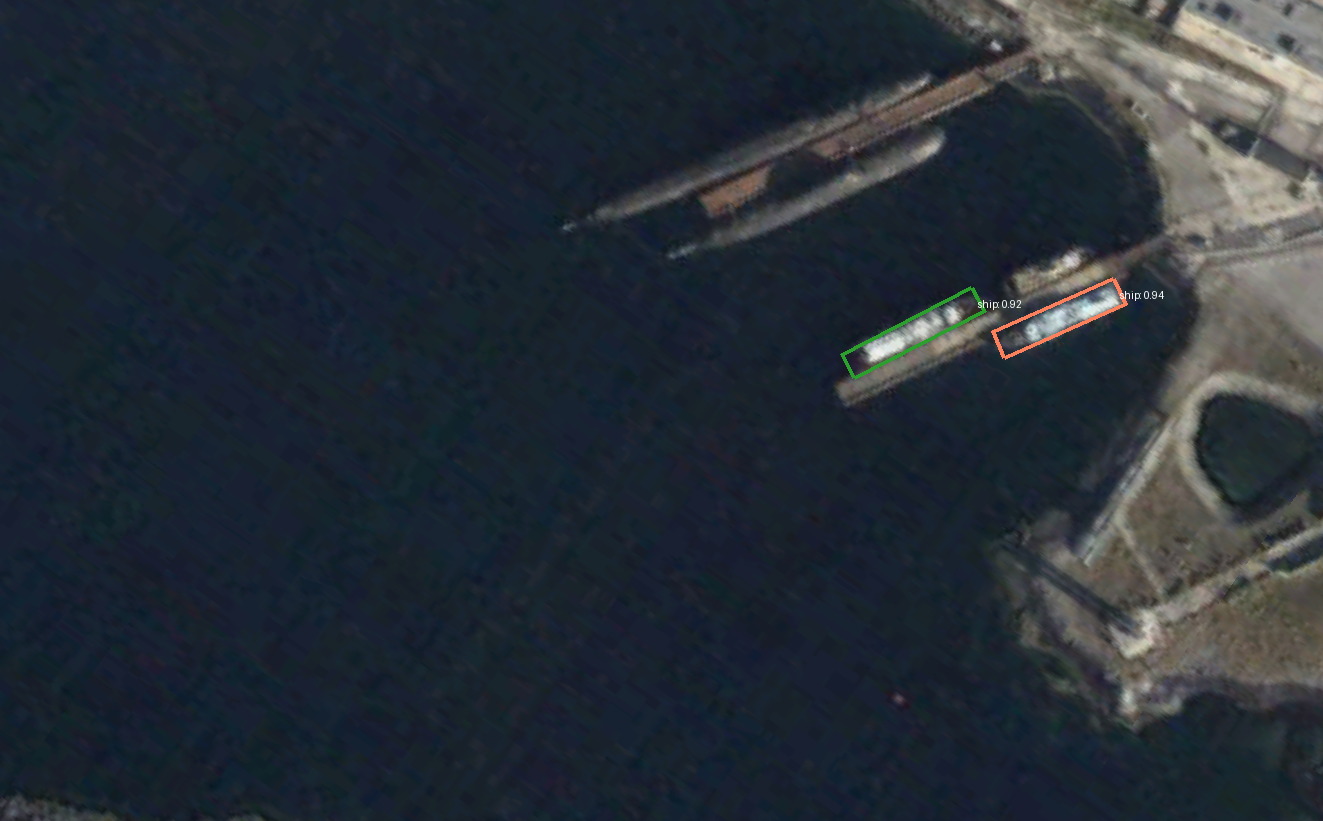
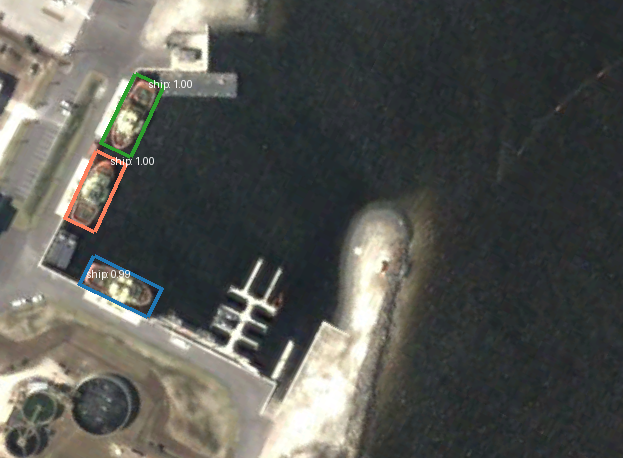
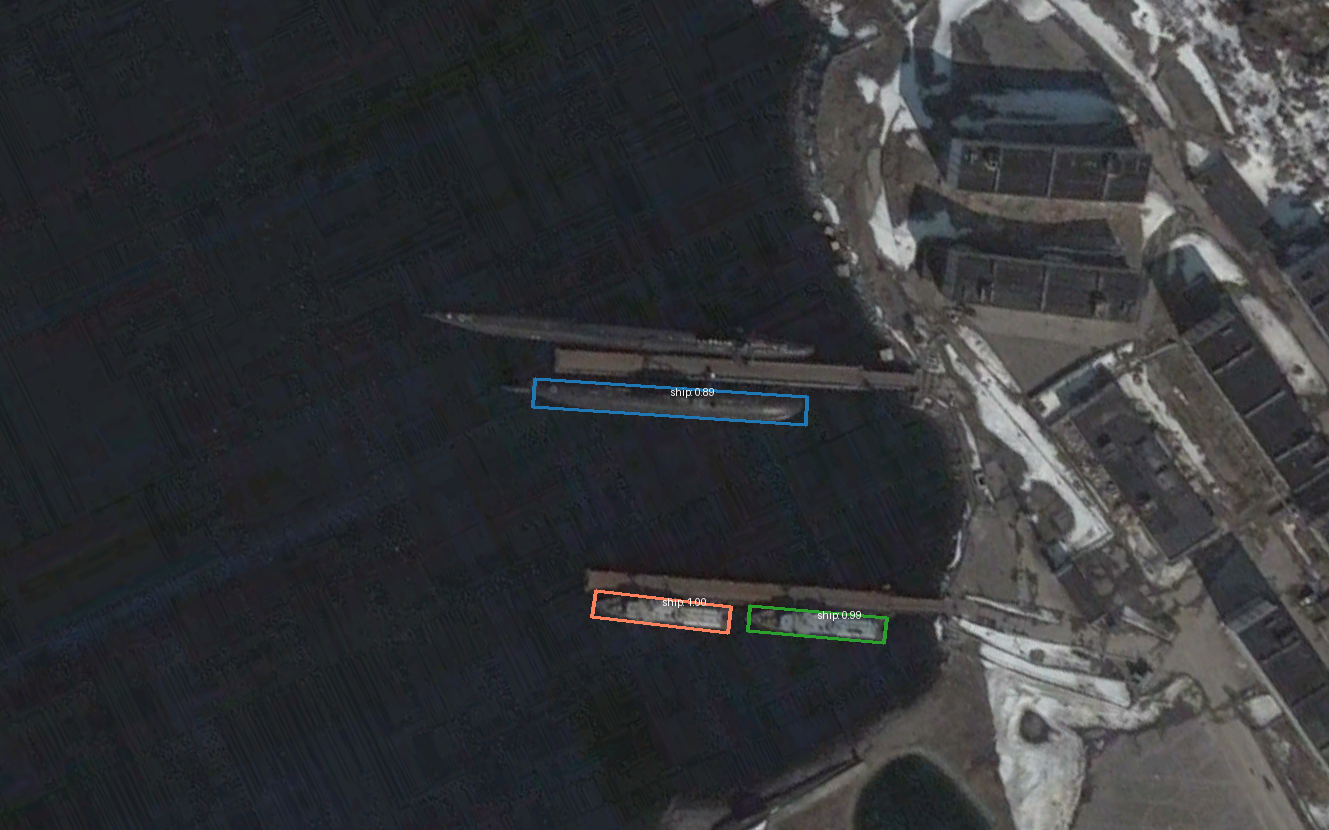
Research illustration only — these are not a dataset mirror. Oriented R-CNN 3× Hub on held-out-style chips (score ≥ 0.85, NMS 0.1):
Recipes Link to heading
Six configs, two schedules, three families. Hub publishes 3× only.
| Family | 1× | 3× (Hub) |
|---|---|---|
| Oriented R-CNN | hrsc2016_le90_1x.json | hrsc2016_le90_3x.json |
| Rotated Faster R-CNN | hrsc2016_le90_1x.json | hrsc2016_le90_3x.json |
| Rotated FCOS | hrsc2016_le90_1x.json | hrsc2016_le90_3x.json |
Shared canvas: keep_ratio, long edge 800, pad_size_divisor 32. Horizontal + vertical + diagonal flips. Batch 2, ResNet-50 FPN, ImageNet backbone, frozen_stages: 1. Train from scratch (load_from_checkpoint: null) — these are not DOTA finetunes.
What changes per family:
| Knob | Oriented R-CNN | Faster R-CNN | FCOS |
|---|---|---|---|
| Box loss | Smooth L1 main + ProbIoU aux 0.1 | ProbIoU main + Smooth L1 aux 0.1 | decoded rIoU |
| LR | 0.005 | 0.005 | 0.0025 |
3× lr_scheduler_gamma | 0.1 | 0.1 | [0.1, 0.5] |
| Random rotate 1× | off | off | on p=0.5 ±20° |
| Random rotate 3× | on p=0.5 ±20° | on p=0.5 ±20° | on (inherited) |
| Deploy score | 0.85 | 0.85 | 0.20 |
3× is 36 epochs, milestones [24, 33]. FCOS keeps a milder second drop (0.5 instead of 0.1) so the decoded-rIoU head does not get wrecked at epoch 33.
A 6× schedule was trained and removed. It was +0.2 mAP on Oriented R-CNN; FCOS 6× never beat this 3×. ±20° is the long schedule. ±180° on FCOS 6× diverged after epoch 12.
NMS is 0.1 everywhere that matters: train val, make eval-val, deploy. Two-stage HRSC keeps max_detections_per_image 2000. That is MMRotate HRSC test-cfg, not the DOTA deploy floor.
Trains Link to heading
Three published runs, single NVIDIA L4, PyTorch 2.3, AMP off, batch 2, 309 steps/epoch on 617 trainval images.
| Model | Run | Wall | Mean epoch | Checkpoint |
|---|---|---|---|---|
| Oriented R-CNN 3× | runs/oriented_rcnn/20260830-163857 | 2h 34m | 4m 17s | best_mAP_0.90.pth |
| Faster R-CNN 3× | runs/rotated_faster_rcnn/20260831-035851 | 1h 5m | 1m 50s | best_mAP_0.89.pth |
| FCOS 3× | runs/rotated_fcos/20260831-020019 | 34m | 57s | best_mAP_0.89.pth |
FCOS is ~4.5× faster to train than Oriented R-CNN on this set. Same ratio we saw on DOTA 1× vs FCOS on L4. Oriented RoIAlign over ~2000 proposals is still the tax.
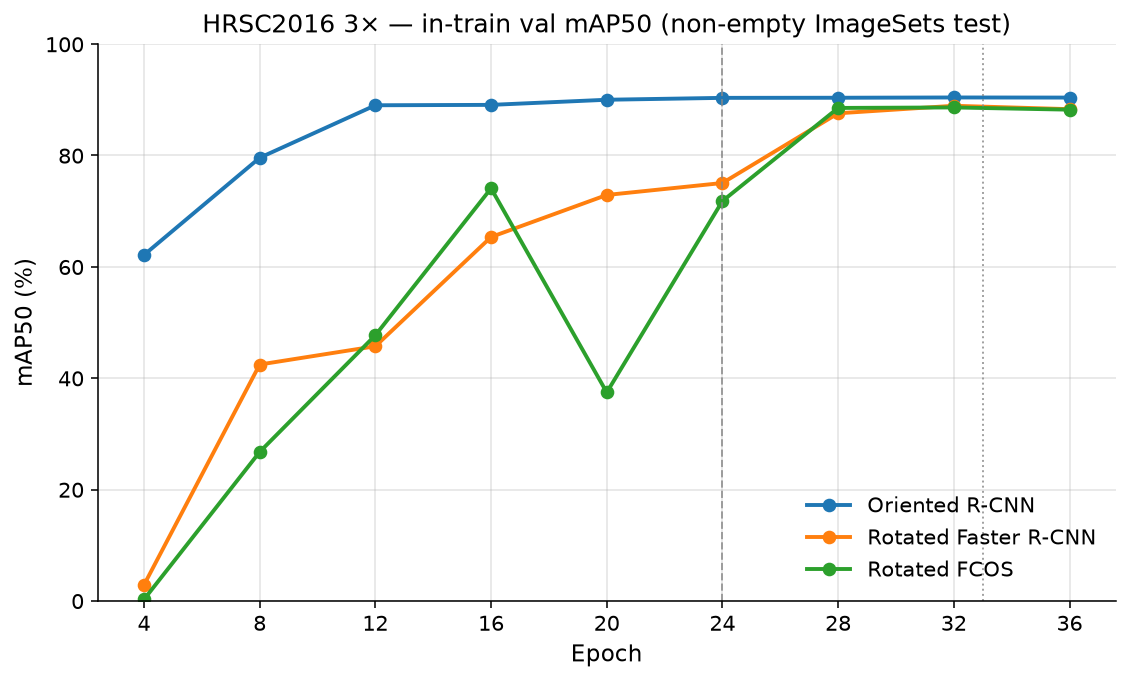
Periodic mAP every 4 epochs (the plot above) is in-train val: 438 non-empty test images, score ≥ 0.05. It is not the Hub number — but it is how the runs actually moved:
- Oriented R-CNN is already at 62% by epoch 4 and 89% by epoch 12. The rest of 3× is a slow polish to 90.4%.
- Faster R-CNN crawls until the first LR drop, then jumps (75% at epoch 24 → 88% at epoch 28).
- FCOS has a real dip at epoch 20 (37%, down from 74% at epoch 16), then recovers after the milestone and sits with Faster R-CNN in the high 88s.
Best checkpoints are not the last epoch. Oriented R-CNN peaked at epoch 32 (90.41% in-train); epoch 36 was 90.39%. Faster R-CNN peaked at 88.92% then 88.31%. FCOS 88.62% then 88.22%. The Hub weights are those best_mAP_*.pth files, re-scored with make eval-val.
# edit dataset.data_root in the config, then:
odet train --config configs/oriented_rcnn/hrsc2016_le90_3x.json
odet train --config configs/rotated_faster_rcnn/hrsc2016_le90_3x.json
odet train --config configs/rotated_fcos/hrsc2016_le90_3x.json
Results Link to heading
Published metric: make eval-val mAP50 on ImageSets test, rotated IoU ≥ 0.50, NMS 0.1, score ≥ 0.05. 453 images. Held-out.
| Model | Hub slug | mAP50 | F1 peak | Deploy --score-thr | Mean best IoU |
|---|---|---|---|---|---|
| Oriented R-CNN 3× | oriented_rcnn_hrsc2016_le90_3x | 90.41% | 0.940 @ 0.90 | 0.85 | 0.848 |
| Rotated Faster R-CNN 3× | rotated_faster_rcnn_hrsc2016_le90_3x | 88.77% | 0.916 @ 0.90 | 0.85 | 0.785 |
| Rotated FCOS 3× | rotated_fcos_hrsc2016_le90_3x | 88.34% | 0.904 @ 0.25 | 0.20 | 0.746 |
Deploy floors are the same rule as DOTA: eval-val global F1 minus 0.05. Two-stage HRSC scores pile up near 1.00, so F1 peaks at 0.90. FCOS F1 peaks at 0.25. Copying --score-thr 0.85 onto FCOS will hide the scene. That is the same decoder ring as the macOS FCOS note.
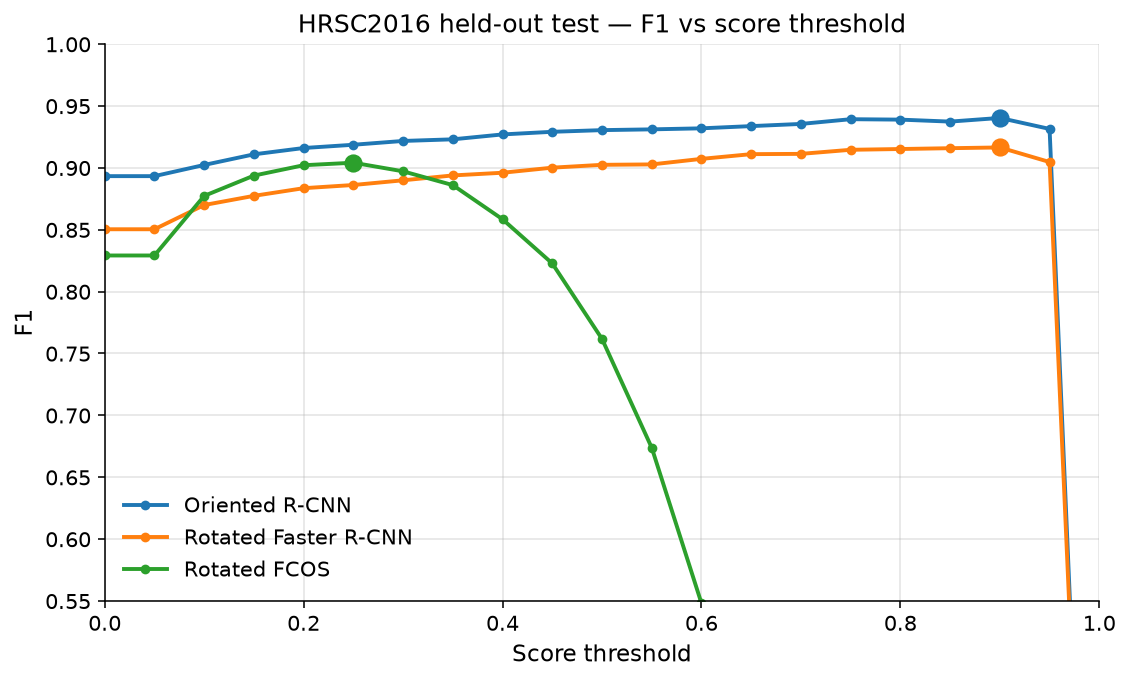
At each model’s F1 operating point:
| TP | FP | FN | Precision | Recall | |
|---|---|---|---|---|---|
| Oriented R-CNN @ 0.90 | 1142 | 59 | 86 | 0.951 | 0.930 |
| Faster R-CNN @ 0.90 | 1108 | 82 | 120 | 0.931 | 0.902 |
| FCOS @ 0.25 | 1108 | 115 | 120 | 0.906 | 0.902 |
Faster R-CNN and FCOS miss the same 120 ships. FCOS pays for its one-stage head with extra false positives. Oriented R-CNN is ahead on both counts, and the boxes are tighter (mean best IoU 0.85 vs 0.79 vs 0.75). That is the accuracy pick on this set.
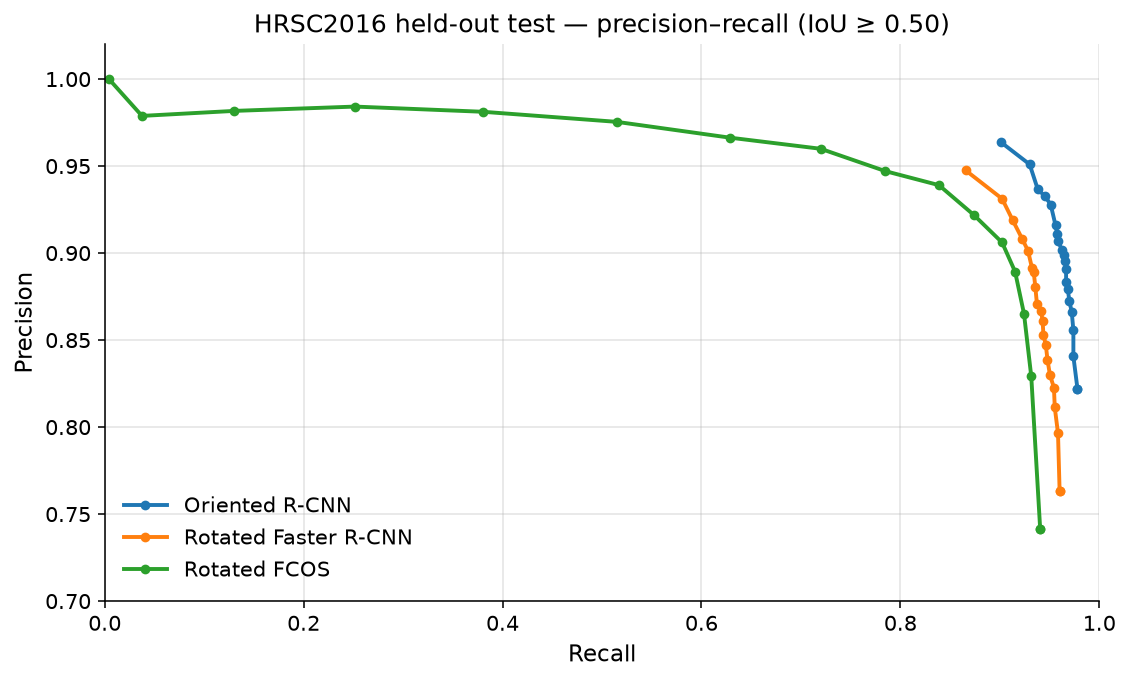
The PR plot is the calibration story in another shape. Two-stage curves live in a high-recall sliver because the scores are peaked. FCOS traces a long high-precision arc down to low recall — usable, just not at 0.85.
Eval reports (per-class AP is one row: ship): oriented_rcnn_hrsc2016_le90_3x, rotated_faster_rcnn_hrsc2016_le90_3x, rotated_fcos_hrsc2016_le90_3x.
Links Link to heading
- oriented-det on GitHub · PyPI · docs — HRSC2016
- Pretrained zoo
- HRSC2016 paper (ICPRAM 2017)
- Previous: Apache 2.0 covers oriented-det. It does not cover DOTA or HRSC. · Oriented-Det v0.2.0
- Next: Lessons learned on DOTA · Oriented-Det v0.3.1