Six weeks after v0.1.1, Oriented-Det v0.2.0 is on PyPI and tagged on GitHub. The headline is a new detector family: Rotated FCOS, an anchor-free single-stage model that sits in the zoo as the balanced pick — close to Rotated Faster R-CNN accuracy, without a region proposal network.
This post is the release note: what landed, which Hub slug to download, and how the loss recipe (not the architecture name) is what moved the number.
Upgrade Link to heading
pip install -U oriented-det
# or pin:
pip install oriented-det==0.2.0
PyTorch is still installed separately for your platform (pytorch.org). Weights stay on Hugging Face at dl4eo/oriented-det-pretrained. The FCOS Hub slug is first-class in the CLI:
odet pretrained download rotated_fcos_dota_le90_1x
Headline: a fourth detector, and a decoded-IoU loss that actually trains Link to heading
v0.2 adds model_type: rotated_fcos. The head follows MMRotate’s Rotated FCOS: DistanceAnglePointCoder (left, top, right, bottom, angle), center-in-OBB assignment, centerness, and a sigmoid focal classifier. There are no anchors and no RPN.
The published FCOS weight is the 1× decoded rIoU checkpoint. Box regression is 1 − differentiable polygon IoU (oriented_det.ops.diff_iou_rotated) — not the Monte-Carlo sampled rIoU used for matching, and not encoded L1. Official DOTA v1.0 Task 1 is 73.07% AP50 — +1.79 versus MMRotate Rotated FCOS 1× (71.28%).
L1 and KFIoU-aux stay as recipes, not Hub downloads. ProbIoU stays the ROI-head recipe for Faster R-CNN; it is not the FCOS default.
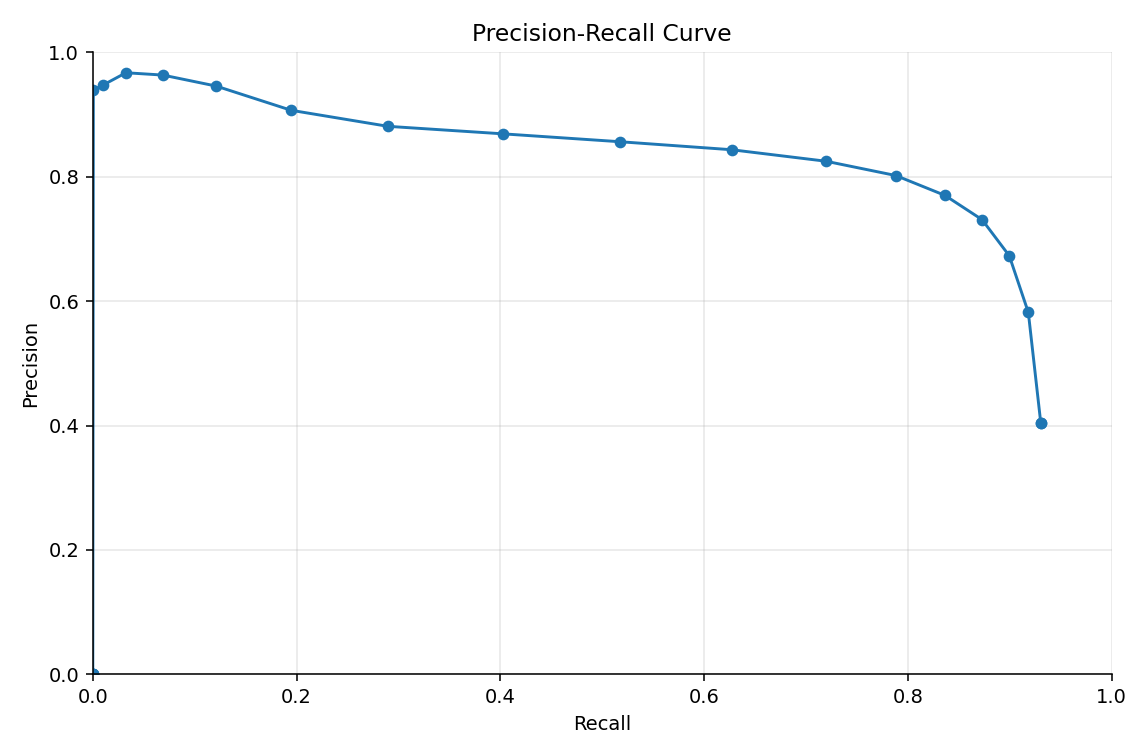
The updated zoo Link to heading
All eight DOTA Hub slugs now have official Task 1 (hidden test). Recipes train on trainval, so local make eval-val is a leaky monitor — do not quote it as the zoo number.
| Model | 1× AP50 | 3× AP50 | Δ AP50 | 1× AP75 | 3× AP75 |
|---|---|---|---|---|---|
| Oriented R-CNN | 76.73% | 74.88% | −1.85 | 50.24 | 51.23 |
| Rotated Faster R-CNN | 74.42% | 74.48% | +0.06 | 41.90 | 45.39 |
| Rotated FCOS | 73.07% | 72.91% | −0.16 | 40.40 | 45.39 |
| Rotated RetinaNet (OBB) | 71.72% | 73.89% | +2.17 | 43.46 | 47.11 |
Slugs are oriented_rcnn_dota_le90_{1x,3x}, rotated_faster_rcnn_dota_le90_{1x,3x}, rotated_fcos_dota_le90_{1x,3x}, rotated_retinanet_dota_le90_{1x,3x}. From 0.3.1 the un-suffixed RetinaNet slugs are OBB; circum-HBB is *_hbb.
Advertise and finetune from 1× for Oriented R-CNN, Faster R-CNN, and FCOS. 3× Task 1 AP50 is a drop or a wash; the 3× gain is box tightness (AP75). RetinaNet 3× is the AP50 exception: +2.17 on the hidden test versus 1×. 1× versus MMRotate 1×: Oriented R-CNN +1.04 vs 75.69, Faster R-CNN +1.02 vs 73.40, FCOS +1.79 vs 71.28, RetinaNet +3.30 vs OBB 68.42.
Default pick. Use oriented_rcnn_dota_le90_1x when you want the highest official Task 1 accuracy. Use rotated_faster_rcnn_dota_le90_1x when you want the throughput / finetune story from July. Use rotated_fcos_dota_le90_1x when you want a one-stage, anchor-free detector in the same Apache 2.0 stack — the roadmap’s balanced tier. RetinaNet stays as the MMRotate-parity legacy baseline; reach for rotated_retinanet_dota_le90_3x if you want that family’s Task 1 peak.
Why decoded rIoU, not another L1 run Link to heading
FCOS can regress boxes three ways in this release:
| Recipe | Box loss | On Hub? |
|---|---|---|
| L1 | Encoded ltrb + wrapped angle | No (local baseline) |
| L1 + KFIoU aux 0.1 | L1 primary, Gaussian KFIoU + heading term | No (recipe + eval report) |
| Decoded rIoU | 1 − polygon IoU | Yes — rotated_fcos_dota_le90_1x |
L1 is stable and underfits the geometry. KFIoU aux recovers some heading on elongated boxes without a CUDA IoU kernel. Putting exact polygon IoU in the training loss is what closed most of the remaining gap to the two-stage zoo.
A 1× ProbIoU-aux FCOS recipe was tried and removed. ProbIoU stays the ROI-head recipe for Faster R-CNN; it is not the FCOS default.
FCOS eval uses evaluation.final_nms_iou_threshold: 0.1 (MMRotate FCOS). For a clean demo use --nms-thr 0.1. Deploy score is 0.20 (local F1-maximizing threshold 0.25 minus 0.05). Do not copy --score-thr 0.60 from the Faster R-CNN harbor demo onto FCOS.
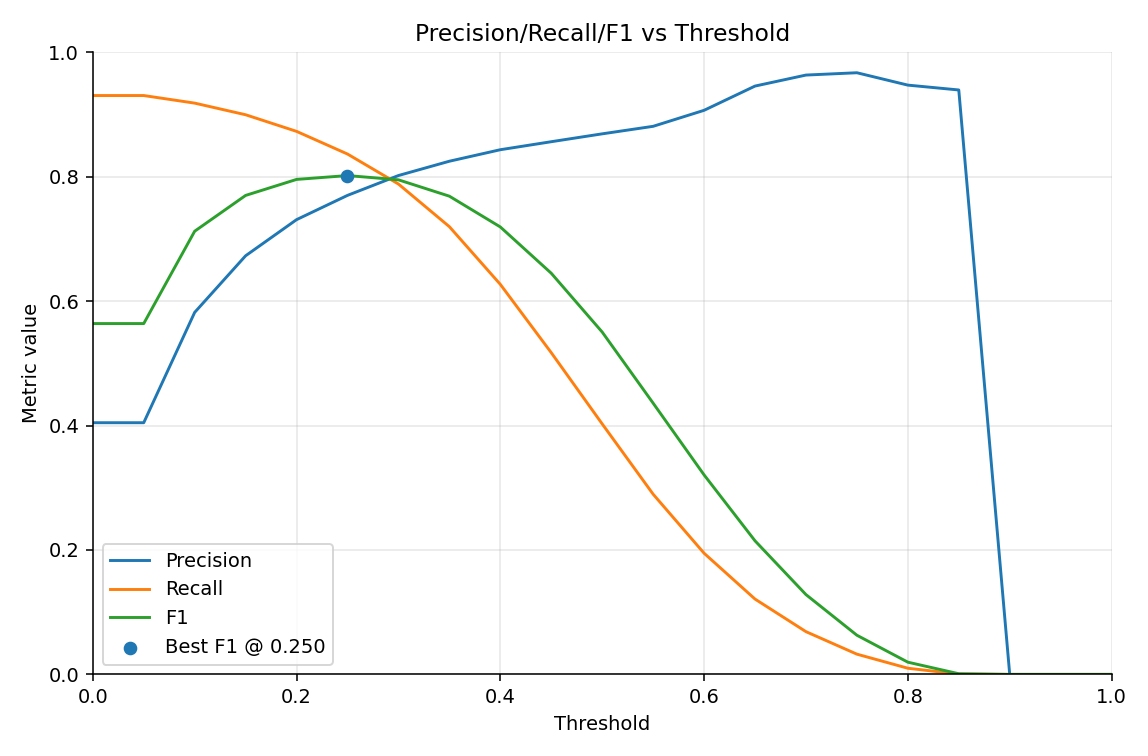
On the local val sweep, F1 peaks at score 0.25 (77.0% precision / 83.6% recall, F1 0.802). That plot is a trainval monitor, not the published Task 1 number. The deploy floor is 0.20.
Where FCOS wins and where Faster R-CNN still leads Link to heading
Mean AP hides class geometry. Official Task 1 AP50:
| Class | FCOS 1× | FRCNN 1× | Δ |
|---|---|---|---|
| large-vehicle | 76.05 | 75.25 | +0.80 |
| helicopter | 64.38 | 63.63 | +0.75 |
| roundabout | 64.61 | 63.01 | +1.60 |
| swimming-pool | 71.66 | 72.27 | −0.61 |
| storage-tank | 84.28 | 84.41 | −0.13 |
| small-vehicle | 79.32 | 79.55 | −0.23 |
| plane | 88.74 | 89.40 | −0.66 |
| ship | 87.28 | 87.85 | −0.57 |
| harbor | 65.09 | 67.09 | −2.00 |
| bridge | 50.71 | 52.03 | −1.32 |
| ground-track-field | 59.88 | 71.39 | −11.51 |
FCOS is competitive on compact and mid-size objects. It is not ahead of Faster R-CNN on tanks or pools on Task 1. The remaining gap is concentrated on elongated classes — especially ground-track-field — the same geometry that made ProbIoU worth the July work. If ships or GTF are the product, start from Faster R-CNN or Oriented R-CNN. If you want a one-stage, anchor-free detector, FCOS 1× rIoU is the default in that lane.
Per-class tables, confusion matrices, and GT-alignment stats: docs/eval-reports/rotated_fcos_dota_le90_1x/.
Try it Link to heading
Same demo tile as the v0.1.1 harbor scene: demo/large.jpg in the oriented-det demo folder (1299×1904, ships at many headings). The DOTA recipe still uses a 1024×1024 canvas, so the image is tiled.
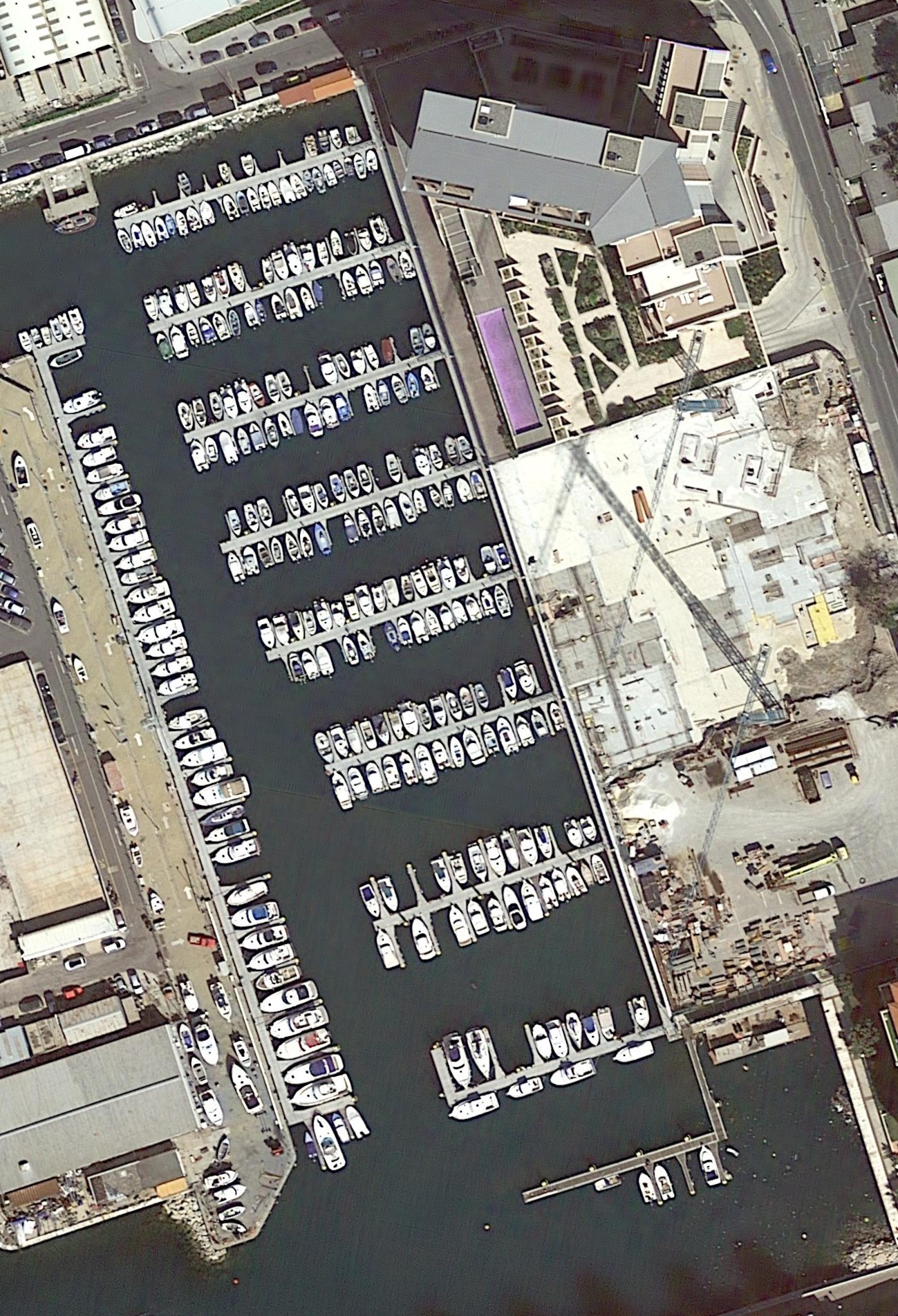
From the oriented-det repository root:
odet pretrained download rotated_fcos_dota_le90_1x

odet image-demo demo/large.jpg hf://rotated_fcos_dota_le90_1x \
  --out-file large_fcos_detections.png \
  --device mps \
  --score-thr 0.20 \
  --nms-thr 0.1
On Apple Silicon use --device mps; on Linux with CUDA, --device cuda:0. Keep --nms-thr 0.1 unless you have a reason to match a two-stage config. Recipes and training commands: configs/rotated_fcos/.
odet train --config configs/rotated_fcos/dota_le90_1x.json
What did not change Link to heading
Apache 2.0, no MMCV runtime, no custom CUDA kernels required to train or evaluate. JSON configs with _base_ inheritance, odet CLI, Hub slugs, eval reports under docs/eval-reports/. The v0.1.1 MMRotate parity fixes for two-stage heads and RetinaNet are unchanged.
What’s next Link to heading
v0.2 closed the “four ResNet-FPN detectors on DOTA” chapter. That chapter’s follow-up shipped as Oriented-Det v0.3.1 — HRSC / FAIR1M / SSDD / HRSID loaders, HRSC Hub 3×, RetinaNet OBB, and ONNX export. The public roadmap next is v0.4: a speed tier (RTMDet-R, native YOLO-OBB) without AGPL dependencies.
Links Link to heading
- Release notes: github.com/DL4EO/oriented-det/releases/tag/v0.2.0
- PyPI: pypi.org/project/oriented-det/0.2.0
- Documentation: dl4eo.github.io/oriented-det
- Pretrained zoo: huggingface.co/dl4eo/oriented-det-pretrained
- FCOS recipes: configs/rotated_fcos
- Previous release: Oriented-Det v0.1.1
- Next: Oriented-Det v0.3.1 · Rotated FCOS vs Oriented R-CNN on macOS