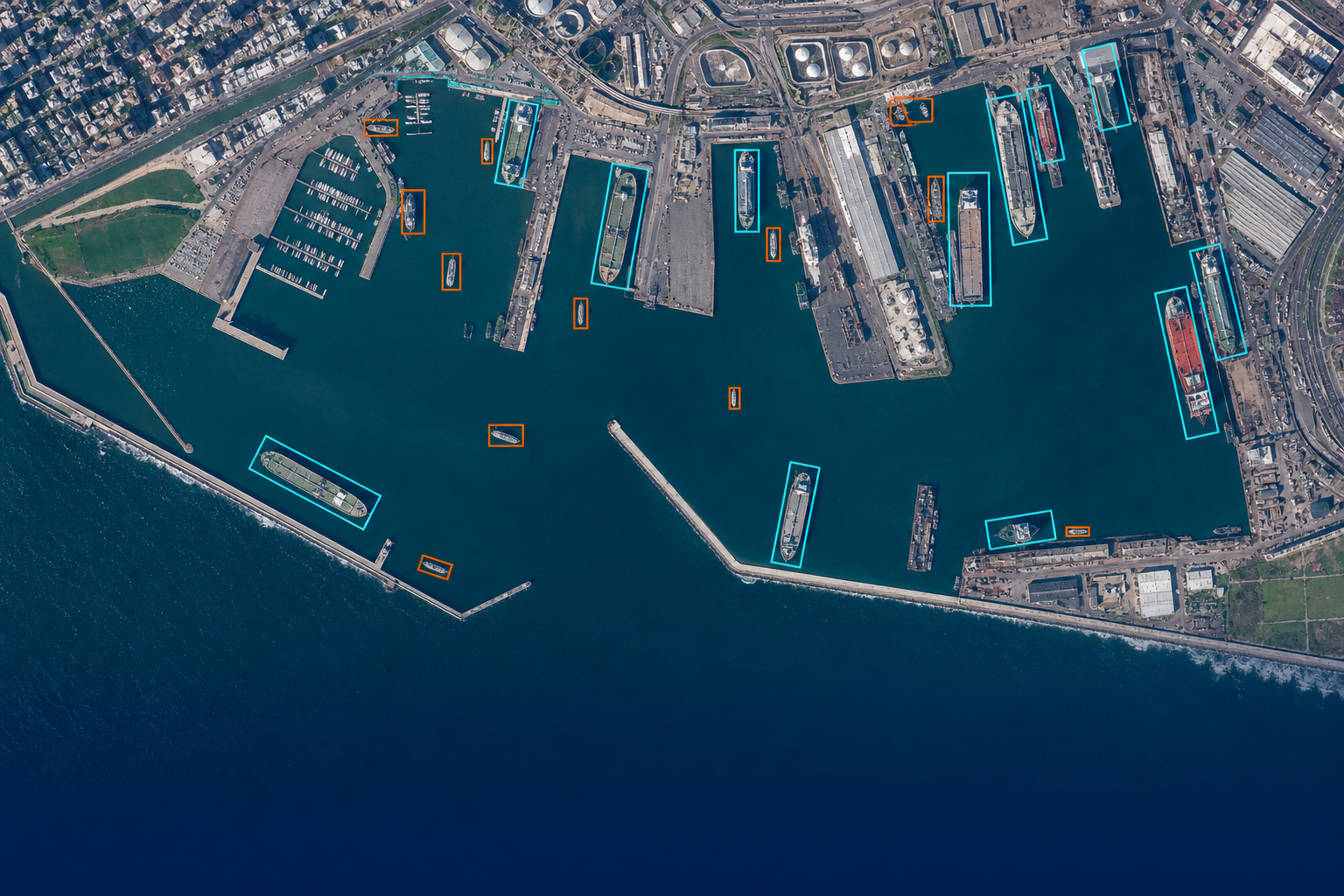
I wanted a rotated detector I could train in ordinary PyTorch.
OrientedDet does that. Matching on the GPU uses a sampled overlap, which is fast. The loss that actually moves the boxes is ProbIoU, a smooth stand-in for the real rotated overlap. The number I publish is still exact polygon IoU on the official DOTA Task 1 server.
The Faster R-CNN weight from that recipe, rotated_faster_rcnn_dota_le90_1x, scores 74.42% on official Task 1. I deploy it at 0.60. The 1× weight is the one I start from. The 3× schedule is for tighter boxes: AP75 45.39 against 41.90.
odet pretrained download rotated_faster_rcnn_dota_le90_1x
How the two overlaps share the work is below.
Two IoU backends, two jobs Link to heading
In OrientedDet, rotated geometry is deliberately split:
| Role | Backend | Exact? |
|---|---|---|
| Training-time anchor / proposal matching | GPU sampled rIoU | Approximate |
| mAP / AP matching (local reports) | CPU Shapely polygon IoU | Exact |
| Final detection NMS (production default) | CPU polygon IoU (final_nms_use_cpu: true) | Exact |
| ROI box regression loss | ProbIoU (+ small Smooth L1 / angle aux) | Surrogate — not polygon IoU |
The default environment flag ORIENTED_DET_ROTATED_BACKEND=gpu_sample routes matching and optional fast eval through our tensor implementation in oriented_det/ops/gpu_ops.py. Set ORIENTED_DET_ROTATED_BACKEND=cpu only for debugging.
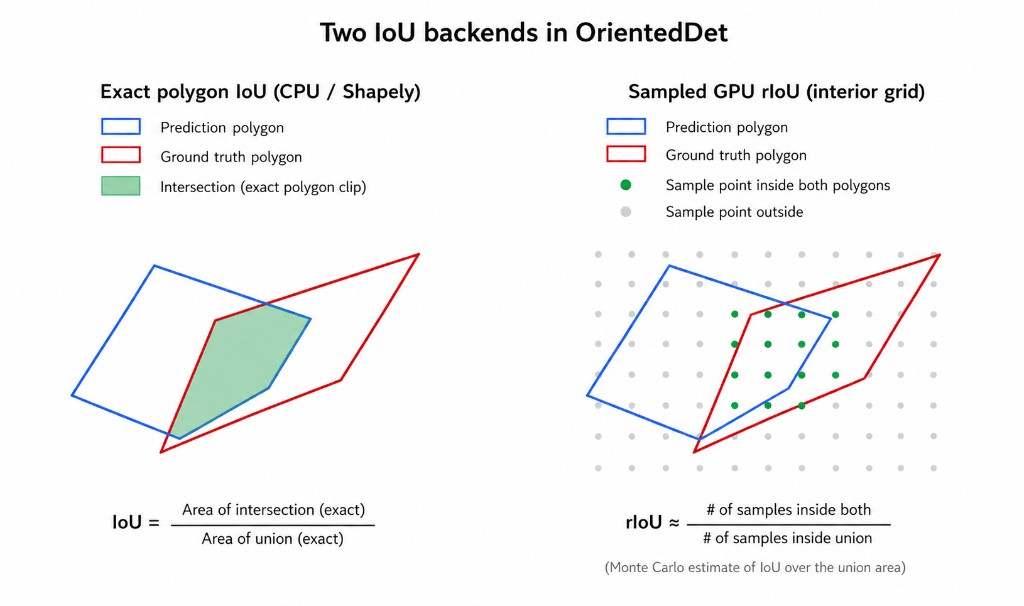
Left: exact polygon clipping (Shapely on CPU, or MMRotate’s CUDA kernels) — intersection area from computational geometry. Right: our GPU path overlays a regular grid on the union and estimates rIoU as the fraction of sample points inside both boxes (a Monte Carlo estimate over the union).
That estimator is fast and fully PyTorch-differentiable for matching, but it is not the same as polygon clipping — and it should not be used as a regression loss or as the number you put in a paper’s mAP table.
Shortcomings of sampled rIoU Link to heading
What MMRotate does Link to heading
MMRotate (via MMCV) implements exact rotated rectangle IoU on the GPU: intersection area from computational geometry, batched across thousands of anchor–GT pairs. Gradients flow through the CUDA kernel where the framework wires IoU-based losses. It is the right tool when you are already inside the OpenMMLab ecosystem and can absorb the build / version matrix.
What sampling gets wrong Link to heading
Our sampler places a √S × √S grid in each box’s local frame (slightly inset from the true corners), then counts points inside both boxes. Error grows when:
- Grid spacing is too coarse along an axis — common for elongated ships (5×100 px) or small vehicles (10–25 px).
- Overlap is high (IoU 0.7–1) — a coarse grid systematically underestimates intersection, so two well-aligned boxes can look worse than they are.
We benchmark sampled IoU against Shapely on synthetic DOTA-like pairs with tools/measure_sampled_riou_error.py. On a vehicle stratum (10–25 px cars/trucks), tightening target spacing from 4 px → 2 px cuts the fraction of pairs with |error| > 10% from 10.1% → 0.2% (at ~3× sample cost):
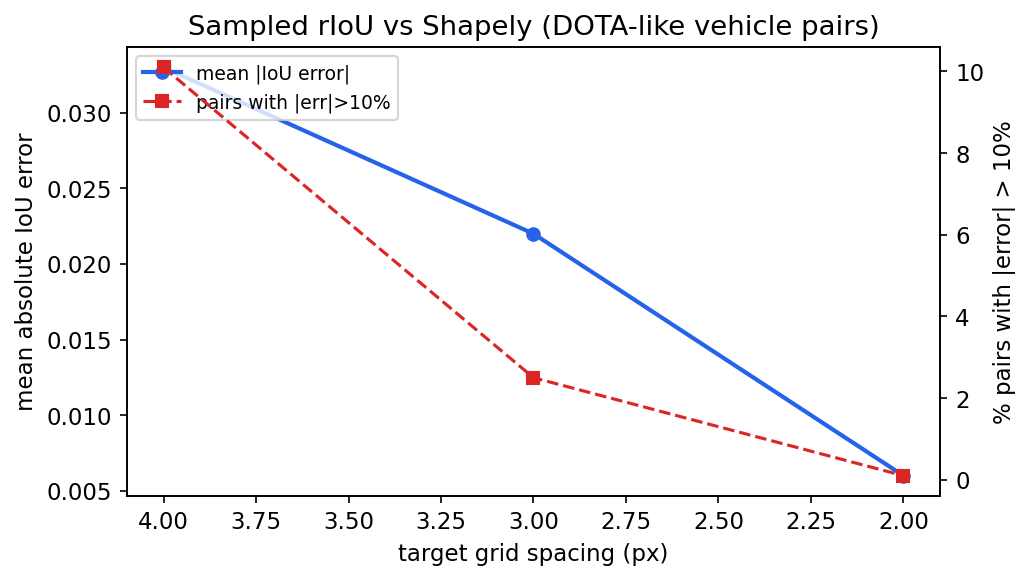
Even with geometry-aware grid sizing (target ~2 px spacing, aspect-ratio boost for thin boxes, clamp 25–1024 samples), high-IoU vehicle pairs still show mean |error| ≈ 0.059 vs 0.130 at 4 px spacing — and 3.2% of pairs still exceed 10% error in the 0.7–1 IoU bin.
Takeaway: sampled rIoU is a practical matching backend in a kernel-free stack. It is a poor loss and a risky metric. We never report published DOTA mAP with it. The number on the Hub is official DOTA v1.0 Task 1 (hidden test). Local make eval-val on DOTA val tiles is a training monitor: those recipes train on trainval, so val is not held out.
Why a full Python version anyway? Link to heading
Deliberate v1 constraints in OrientedDet:
- No MMCV / MMDet / MMRotate at runtime — install is
pip install+ PyTorch, not a compiled ops zoo. - No in-repo CUDA kernels — everything ships as Python and torch ops; CI and contributors don’t need matching CUDA toolchains.
- Explicit backend policy —
rotated_ops.pycan gain a futurecuda_exactbackend without rewriting models. - Honest metrics — Shapely polygon IoU for mAP; CPU NMS for production decode when configured.
Satellite teams often want to fork, ablate, and deploy without dragging an entire detection framework. A pure-Python core trades some raw matching throughput for portability and clarity. Where profiling later proves CUDA exact IoU is worth it, we can add it behind the same switch — without making it a day-one dependency.
ProbIoU: a surrogate aligned with orientation Link to heading
Training ROI box regression with sampled rIoU loss would optimize the wrong objective: gradients would push boxes toward better grid counts, not better polygon overlap. MMRotate users typically use KFIoU, GWD, or similar surrogates, or exact IoU where available.
We use ProbIoU (Probabilistic IoU for Oriented Object Detection, Lv et al.) as the main ROI regression loss:
- Map each OBB ((c_x, c_y, w, h, \theta)) to a 2D Gaussian (variance (w^2/12), (h^2/12), rotated with (\theta)).
- Measure dissimilarity via Bhattacharyya distance between Gaussians.
- Convert to a bounded loss in ([0, 1]) (L1 mode) suitable for stable training.
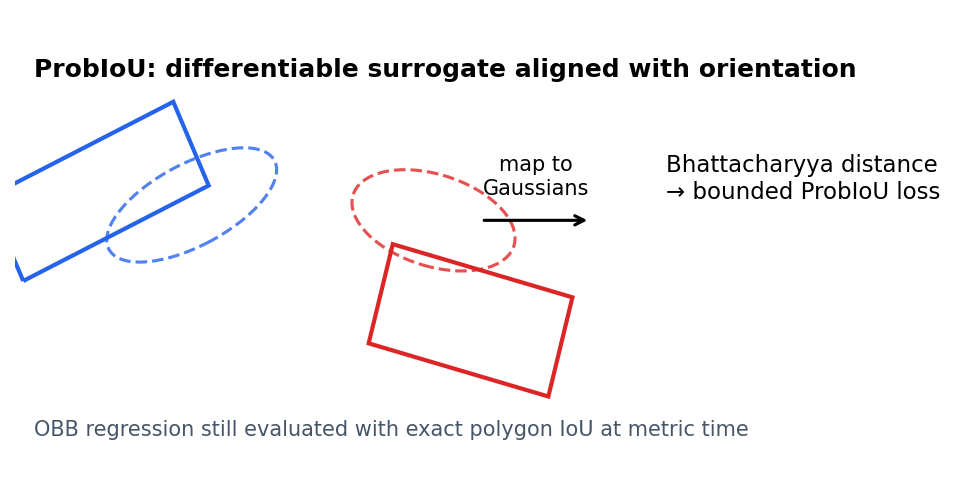
Implementation lives in oriented_det/ops/probiou.py — pure PyTorch, fp32-stable, no custom ops.
Recipe for the published 1× model (configs/rotated_faster_rcnn/dota_le90_1x.json):
"roi_box_reg_main_loss_type": "probiou",
"roi_box_reg_probiou_mode": "l1",
"roi_box_reg_smooth_l1_aux_weight": 0.1,
"roi_box_reg_angle_weight": 1.0
ProbIoU drives center, scale, and angle jointly. A light Smooth L1 auxiliary on the encoded targets keeps optimization well-conditioned; a separate angle weight prevents periodic angle collapse on near-square objects (common on DOTA).
At metric time, official scores come from the DOTA evaluation server (VOC Task 1). Local reports still use exact polygon IoU — comparable protocol, not the surrogate.
Published 1× checkpoint: official Task 1 Link to heading
Experiment: runs/rotated_faster_rcnn/20260907-124458
Model: Rotated Faster R-CNN, ResNet-50 FPN, DOTA v1.0 le90, 1024×1024 tiles, overlap 200
Schedule: 12 epochs (1×), LR milestones at epochs 8 and 11, ProbIoU main + Smooth L1 aux
Wall time: 11h 30m on a single NVIDIA L4 (FP32)
This article is the throughput / finetune chapter, not the zoo-leader post. Among the ResNet families, the Task 1 leader is Oriented R-CNN 1× at 76.73% (MMRotate Oriented R-CNN 1×: 75.69%). v0.4.0 later put Rotated RTMDet-S at 77.60%. Here the claim is narrower: ProbIoU Rotated Faster R-CNN beats MMRotate’s Rotated Faster R-CNN on the hidden test.
Official DOTA v1.0 Task 1 (VOC) Link to heading
Published DOTA numbers are evaluation-server VOC Task 1. DOTA recipes train on trainval, so local make eval-val on val tiles is a training monitor, not a held-out score.
| Model | Schedule | ROI regression | Task 1 AP50 | Task 1 AP75 |
|---|---|---|---|---|
| Rotated Faster R-CNN 1× (this checkpoint) | 12 epochs | ProbIoU + aux | 74.42% | 41.90 |
| MMRotate Rotated Faster R-CNN 1× | 12 epochs | Smooth L1 | 73.40% | — |
| Oriented R-CNN 1× (ResNet-family leader) | 12 epochs | Smooth L1 | 76.73% | 50.24 |
+1.02 AP50 versus MMRotate’s Rotated Faster R-CNN 1× zoo number, from changing the box-regression objective — not from a longer schedule.
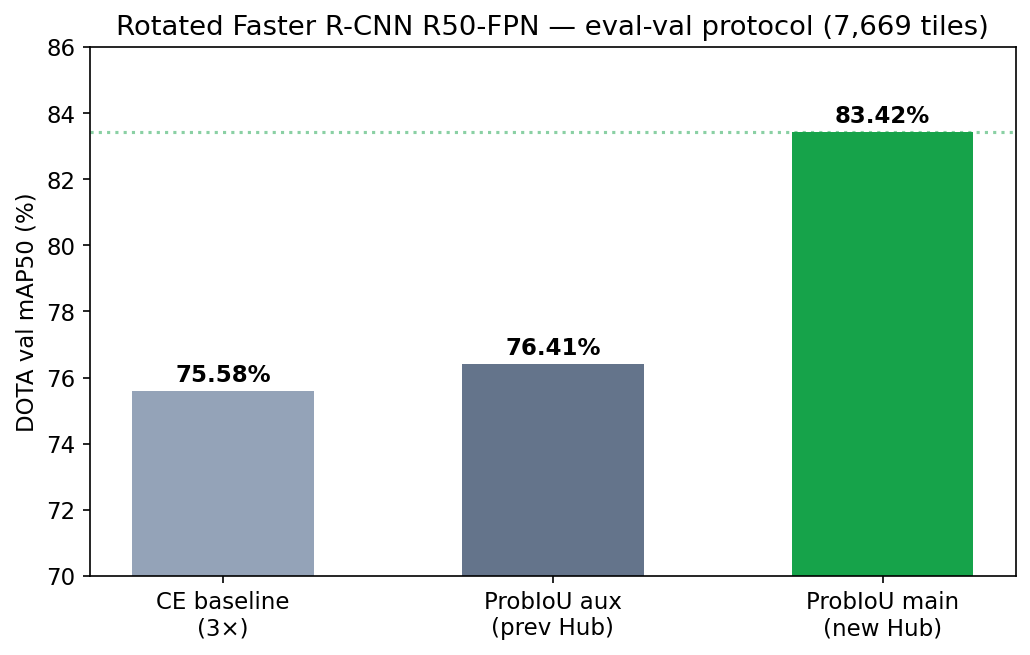
Per-class Task 1 AP50 (this checkpoint) Link to heading
| Class | AP50 | Class | AP50 |
|---|---|---|---|
| tennis-court | 90.11 | plane | 89.40 |
| ship | 87.85 | storage-tank | 84.41 |
| baseball-diamond | 81.74 | small-vehicle | 79.55 |
| basketball-court | 79.48 | large-vehicle | 75.25 |
| swimming-pool | 72.27 | ground-track-field | 71.39 |
| harbor | 67.09 | helicopter | 63.63 |
| roundabout | 63.01 | soccer-ball-field | 59.04 |
| bridge | 52.03 | mAP50 | 74.42 |
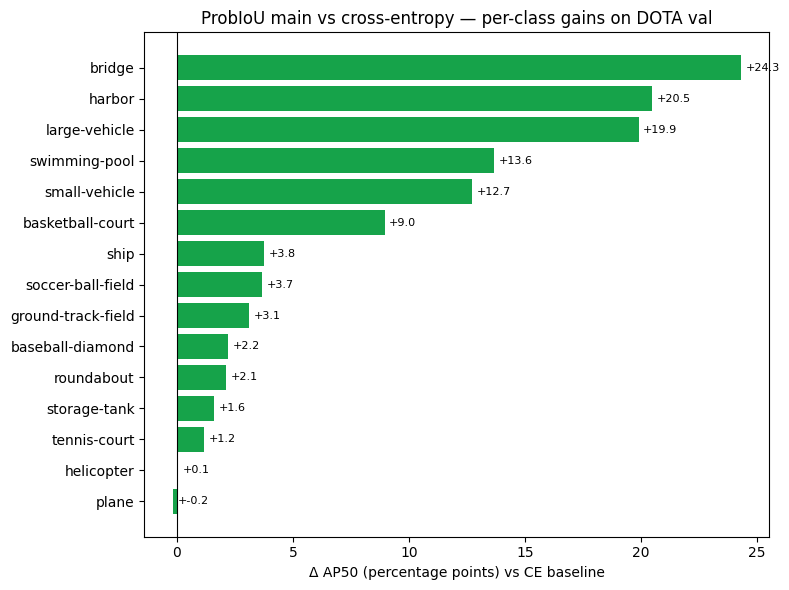
Oriented R-CNN still leads on large-vehicle (82.54 vs 75.25) and harbor (73.33 vs 67.09). Rotated Faster R-CNN is slightly ahead on small-vehicle and swimming-pool. The Hub report: docs/eval-reports/rotated_faster_rcnn_dota_le90_1x/model_analysis.md.
When 3× is worth it Link to heading
Official Task 1 is on the Hub for all four ResNet DOTA families at 1× and 3×. AP50: Oriented R-CNN drops (76.73 → 74.88), Faster R-CNN is a wash (74.42 vs 74.48), FCOS drops slightly (73.07 → 72.91). RetinaNet 3× is the exception (73.89% vs 1× 71.72%, OBB from 0.3.1). AP75 is the 3× tightness gain (Oriented R-CNN 51.23 vs 50.24, Faster R-CNN 45.39 vs 41.90, FCOS 45.39 vs 40.40, RetinaNet 47.11 vs 43.46). Finetune two-stage and FCOS from 1×. Reach for a 3× slug only if you need tighter boxes, or if you want RetinaNet’s Task 1 peak (rotated_retinanet_dota_le90_3x). Circum-HBB is *_hbb. v0.4.0 is outside this pair: RTMDet-S has one Hub weight, the 3×, at 77.60% AP50 and 52.01 AP75.
Inference speed vs Oriented R-CNN Link to heading
Throughput is architectural. Timings below are one 1024×1024 forward per DOTA val tile, production.* decode, exact CPU polygon NMS (inference_loop_seconds on 7,669 tiles, CUDA). They are not a substitute for Task 1.
| Model | Task 1 AP50 | Total inference | Throughput | ms / image |
|---|---|---|---|---|
| Rotated Faster R-CNN 1× | 74.42% | 20.5 min | 6.25 img/s | 160 |
| Oriented R-CNN 1× | 76.73% | 140.5 min | 0.91 img/s | 1,100 |
Rotated Faster R-CNN is ~6.9× faster on tiled inference — and emits fewer raw detections (≈14 vs ≈25 boxes per image at score ≥ 0.05), which also keeps CPU NMS cheaper.
Why the gap?
- RoIAlign geometry — Rotated Faster R-CNN uses horizontal RoIAlign on horizontal RPN proposals; Oriented R-CNN uses rotated RoIAlign on oriented proposals (heavier per-RoI sampling).
- Proposal volume — Oriented R-CNN’s midpoint-offset RPN tends to produce more candidates before NMS, increasing head and NMS work.
- Same honest NMS — both runs use CPU polygon final NMS when
final_nms_use_cpu: true; the speedup is architectural, not a metric cheat.
Training epochs show the same pattern: ~58 min/epoch (Rotated Faster R-CNN 1×, 11h 30m wall) vs ~3h 1m/epoch (Oriented R-CNN 1×, 1d 12h 22m wall) on the same tile recipe.
Weights are on the Hub Link to heading
The published checkpoint is the 1× ProbIoU weight — also the finetune default:
| Field | Value |
|---|---|
| Hub slug | rotated_faster_rcnn_dota_le90_1x |
| Repository | dl4eo/oriented-det-pretrained |
| Filename | rotated_faster_rcnn_r50_fpn_dota_le90_1x-1e3dabeb.pth |
| SHA256 | 1e3dabeba821e8497e987f434feedb974b3cc8775f1a5538562969792621a06c |
| Official Task 1 AP50 | 74.42% |
| Config | configs/rotated_faster_rcnn/dota_le90_1x.json |
| Deploy | --score-thr 0.60 --nms-thr 0.1 |
Download:
pip install oriented-det
odet pretrained download rotated_faster_rcnn_dota_le90_1x
Use in training / inference config:
"load_from_checkpoint": "hf://rotated_faster_rcnn_dota_le90_1x"
Try it Link to heading
git clone https://github.com/DL4EO/oriented-det.git
cd oriented-det
pip install -e .

# Download published weights
odet pretrained download rotated_faster_rcnn_dota_le90_1x

# Train / finetune from the 1× recipe
make train CONFIG=configs/rotated_faster_rcnn/dota_le90_1x.json

# Local training monitor (DOTA trainval — not the published Task 1 number)
make eval-val EXPERIMENT=runs/rotated_faster_rcnn/20260907-124458
Benchmark sampled IoU error yourself:
python tools/measure_sampled_riou_error.py --pairs 1400 --seed 0
References Link to heading
- Lv et al., Probabilistic IoU for Oriented Object Detection, arXiv:2106.06072
- MMRotate / MMCV rotated IoU CUDA ops — MMRotate
- OrientedDet ops policy and benchmarks —
oriented_det/ops/README.md - Pretrained zoo —
pretrained/README.md
Links Link to heading
- OrientedDet on GitHub
- Pretrained weights on Hugging Face
- Earlier posts in this series: sliding-window inference, macOS pure-Python inference
July 10, 2026 — Jeff Faudi