A plane on a taxiway, a ship against a quay, a bus in a diagonal row: the interesting part of the box is the angle.
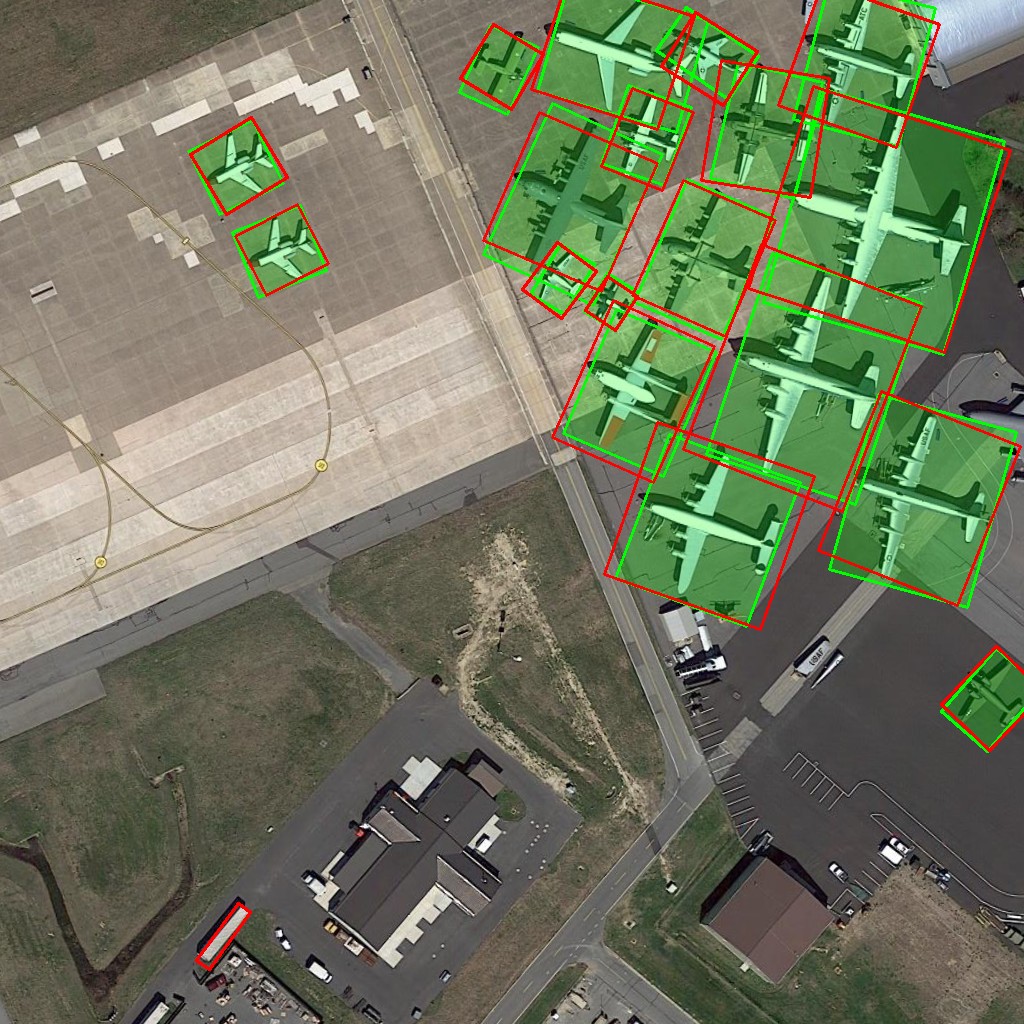
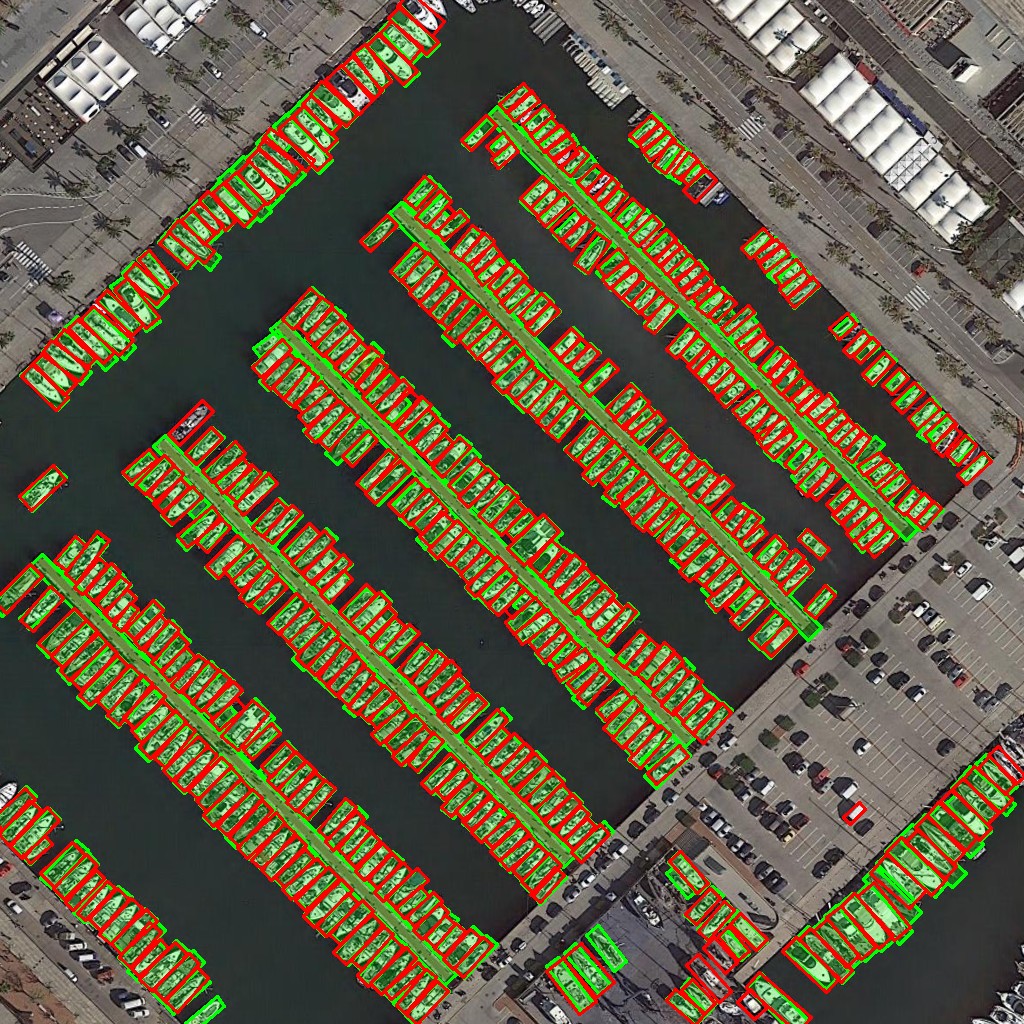
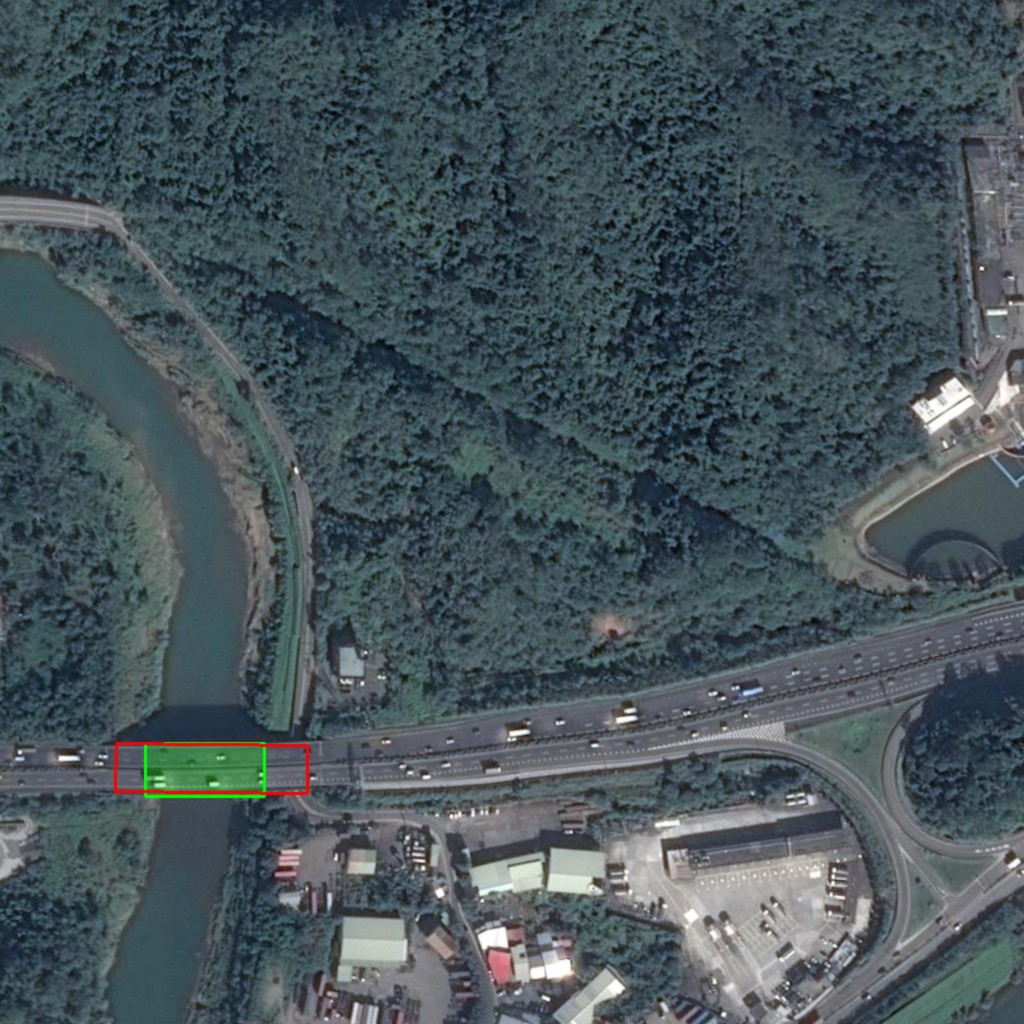
These are Oriented R-CNN detections on the fifteen classes of DOTA v1.0. The box follows the object. The gallery is below.
What is DOTA? Link to heading
DOTA is a large-scale dataset for object detection in aerial images. DOTA v1.0 contains 2,806 images and 188,282 annotated object instances across 15 common categories. Objects are annotated as arbitrary quadrilaterals, which makes the dataset a natural benchmark for oriented bounding box detectors.
The official dataset page lists imagery from several sources:
- Google Earth
- GF-2 and JL-1 satellite imagery provided by the China Centre for Resources Satellite Data and Application
- Aerial images provided by CycloMedia B.V.
The usage terms are important. According to the official DOTA dataset page, use of Google Earth images must respect the Google Earth terms of use, and all DOTA images and associated annotations can be used for academic purposes only; commercial use is prohibited.
For practical EO work, that means DOTA is best treated as a public research benchmark: useful for comparing architectures, validating geometry, and building intuition, but not a source of commercial training imagery.
The 15 DOTA v1.0 classes Link to heading
DOTA v1.0 defines the following original classes:
| Class | Why orientation matters |
|---|---|
| Plane | Aircraft heading and footprint are naturally rotated on aprons and runways. |
| Ship | Harbors and waterways create dense scenes where axis-aligned boxes overlap heavily. |
| Storage tank | Circular objects are easy, but dense tank farms still benefit from precise localization. |
| Baseball diamond | The object footprint is strongly geometric and rarely axis-aligned. |
| Tennis court | Courts appear in repeated grids and rotated urban layouts. |
| Basketball court | Small rectangular sports facilities are sensitive to box angle. |
| Ground track field | Large elongated sports fields need oriented extent rather than loose rectangles. |
| Harbor | Harbors are large, irregular, and often packed with ships and infrastructure. |
| Bridge | Long thin structures are one of the clearest cases for oriented boxes. |
| Large vehicle | Trucks and buses appear at arbitrary parking and road angles. |
| Small vehicle | Dense vehicle areas quickly become cluttered with horizontal boxes. |
| Helicopter | Small aircraft need accurate orientation when parked close to other assets. |
| Roundabout | Circular road structures are visually distinctive but context-dependent. |
| Soccer ball field | Field boundaries are rectangular and frequently rotated. |
| Swimming pool | Pools vary in size and orientation across dense urban scenes. |
What we are showing Link to heading
The detections below are produced with Oriented R-CNN, using the DOTA-style oriented bounding box setup from oriented-det. The ground truth provided by DOTA is displayed in green ; predictions by Oriented-Det are displayed in red (all classes).
Oriented R-CNN is a good baseline for this visual tour because it combines a strong two-stage detector with oriented region prediction. Instead of returning horizontal boxes that include too much background, it predicts rotated boxes aligned with the object footprint. For EO imagery, that difference is not cosmetic: it affects duplicate suppression, dense-scene readability, footprint estimation, and downstream workflows where orientation is part of the information. These illustrations were created with the published oriented_rcnn_dota_le90_1x checkpoint (--score-thr 0.55 --nms-thr 0.1).
Each illustration highlights one DOTA class. The goal is not to claim perfect production performance from a benchmark checkpoint. The goal is simpler: show what oriented detections look like across the full original DOTA label set.
Detection gallery Link to heading
Plane Link to heading
Ship Link to heading
Storage tank Link to heading

Baseball diamond Link to heading

Tennis court Link to heading

Basketball court Link to heading

Ground track field Link to heading

Harbor Link to heading

Bridge Link to heading
Large vehicle Link to heading

Small vehicle Link to heading

Helicopter Link to heading

Roundabout Link to heading

Soccer ball field Link to heading

Swimming pool Link to heading

References Link to heading
- DOTA dataset
- DOTA dataset page: image source, usage license, and object categories
- Google Earth terms of use
- oriented-det on GitHub
- Previous post: Oriented-Det v0.1.0 is out
- Next: Oriented object detection on macOS, in pure Python